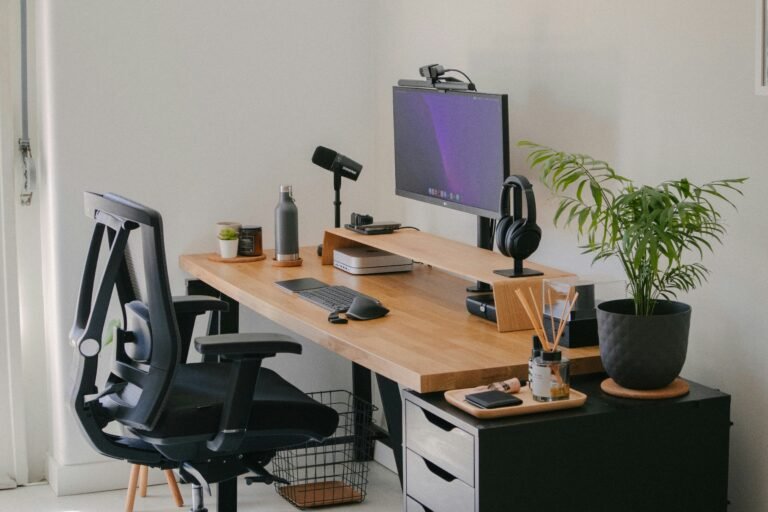
A wall-mounted foldable desk is one of the most effective space-saving investments you can make in a small home. When closed, it occupies just a few centimetres from the wall. When open, it becomes a proper working surface. The catch is that installation is permanent – you are committing to a fixed position on a specific wall – so it is worth thinking carefully before you drill.
This guide covers the best options available in the US right now, how to choose the right size and style, and what to consider before mounting.
Why a Folding Wall Desk Makes Sense
Standard desks in small rooms create a problem even when you are not using them – they still take up floor space. A wall-mounted fold-down desk eliminates that. Folded up, it sits flush or near-flush with the wall. Folded down, you have a dedicated workspace.
They work particularly well in:
- Spare rooms that double as guest bedrooms
- Hallways and landings with enough wall clearance
- Living rooms where a permanent desk would dominate
- Small home offices where every square metre counts
The tradeoff is that you cannot easily move them, cable management is trickier than with a freestanding desk, and installation requires wall fixings that can hold the weight of the desk plus anything you put on it.
What to Look For
Size: Most fold-down desks offer between 60 cm and 100 cm of width. Match this to how you actually work – a laptop-only setup needs less than a dual-monitor arrangement.
Depth when open: Typical depth is 40-50 cm. That is enough for a laptop, but a monitor will sit very close to your face at that depth. If you need a full monitor setup, look for desks with 50 cm or more of depth.
Weight capacity: Most budget options are rated around 25-30 kg. That is fine for a laptop and accessories, but check the rating if you plan to put a monitor, printer, or external hard drives on the surface.
Storage: Some fold-down desks include shelving above the work surface that remains accessible when the desk is folded. This is useful for keeping your home office clutter contained.
Finish and material: MDF with a veneer or painted finish is most common. Solid wood options exist but cost significantly more. Consider whether the desk needs to match existing furniture.
Top Picks
1. IKEA NORBERG Wall-Mounted Drop-Leaf Table
The NORBERG is technically a dining table, but it is one of the most popular fold-down work surfaces in the US for good reason. It is compact (74 x 60 cm when open, 74 x 10 cm when folded), simple, and cheap. The white finish fits almost any room. It supports up to 50 kg when both legs are extended.
The limitation is that it has no built-in storage and is quite shallow at 60 cm depth – better suited to laptop use than a full desktop setup. But at its price point, it is hard to fault.
Best for: Minimal setups, tight budgets, rooms where the desk needs to disappear completely
2. SKLUM Winnie Fold-Down Desk
A more desk-specific option than the NORBERG, the Winnie features a proper work surface (90 x 45 cm) with a small shelf integrated into the unit. Available in multiple colours including white, black, and natural wood effect. The fold-down mechanism is smooth and the shelf stays usable when the desk is closed, giving you somewhere to store a notebook or router without wasting the wall space.
Build quality is solid for the price range and it is straightforward to install if you are comfortable with wall fixings.
Best for: People who want a bit of storage combined with the desk, medium-sized spaces
3. Prepac Wall-Mounted Floating Desk with Storage
Prepac’s fold-down desk is a more substantial unit – the surface is around 92 cm wide and 46 cm deep, and the unit includes a corkboard panel plus a shelf when open. Closed, it has two open shelves accessible from the front, which you can use for books or office supplies.
It is taller than most fold-down options because of the built-in shelving, so measure your available wall height carefully. Assembly and installation take longer than simpler options, but the result is more functional.
Best for: Home offices that need surface area plus storage, people comfortable with a larger installation project
4. HOMCOM Wall-Mounted Floating Desk
HOMCOM produce a range of fold-down desks at mid-range prices. Their most popular home office variant offers a 100 cm wide surface with a small shelf and hooks on the underside for headphones or cables. The brown or white finishes work well in most rooms.
Construction is MDF on a metal frame. The folding mechanism feels robust and has held up well in extended use. Installation requires two people – the unit is heavy enough that aligning it with wall studs while holding it in place is a two-person job.
Best for: Wider work surfaces, anyone who wants hooks for cable management
5. Murphy Bed with Integrated Desk (e.g. Bestar Lumina)
If your goal is maximum space recovery, a Murphy bed with a fold-out desk integrated into the frame takes this concept to its logical extreme. When the bed is up, the desk is available. When the desk folds away, the bed comes down. These are significantly more expensive and require careful installation, but they are the gold standard for spare room conversion.
US availability is more limited than in the US – check Bestar, Expand Furniture, and bespoke fitted furniture companies for options.
Best for: Spare rooms that need to function as both bedroom and home office
Planning Your Installation
Before buying, measure the following:
- Wall width: Ensure the desk fits with clearance on both sides for comfortable use
- Wall height: Some desks with integrated shelving are quite tall – check you have enough clearance above the desk position for the full unit
- Chair space: When the desk is folded down, you need enough floor space in front of it to sit comfortably – typically 80-100 cm
- Stud positions: Most fold-down desks need to fix into wall studs for a secure installation. Use a stud finder before buying, and confirm that stud positions align with the desk’s fixing points
Not sure where to position the desk, or how the room will flow around it? A floor plan tool can help you experiment with placement before committing to drilling.
Plan your room layout free with Planner 5D →
Disclosure: This article contains affiliate links. If you buy through our links, we may earn a small commission at no extra cost to you.
Installation Tips
Use a spirit level. A desk that is even slightly off-level becomes noticeable every time you use it – pens roll, drinks tip. Take the extra two minutes.
Fix into studs or use proper cavity anchors. The desk plus your arms resting on it puts significant lateral load on the fixings. A desk that pulls away from the wall is a safety hazard. If you cannot hit studs, use heavy-duty cavity wall anchors rated for the load.
Cable management from the start. It is much easier to think about cables before installation than after. Consider where power and data cables will run before you commit to a wall position.
Two people for the lift. Most fold-down desk units are heavier than they look. Have someone hold the unit against the wall while you mark and drill.
Summary
| Desk | Width | Depth | Storage | Best For |
|---|---|---|---|---|
| IKEA NORBERG | 74 cm | 60 cm | None | Minimal setups |
| SKLUM Winnie | 90 cm | 45 cm | Small shelf | Compact offices |
| Prepac Floating | 92 cm | 46 cm | Shelf + cork | Storage needed |
| HOMCOM | 100 cm | 45 cm | Shelf + hooks | Wider surface |
| Murphy + Desk | Varies | Varies | Full unit | Dual-purpose rooms |
A wall-mounted foldable desk is one of those purchases that repays the upfront effort many times over. The planning stage – getting the wall position right, checking for studs, thinking about how the room will flow – is where most of the value is created. The desk itself is almost the easy part.