
Window Films for Privacy, Glare, Heat and Home Office Safety in 2026

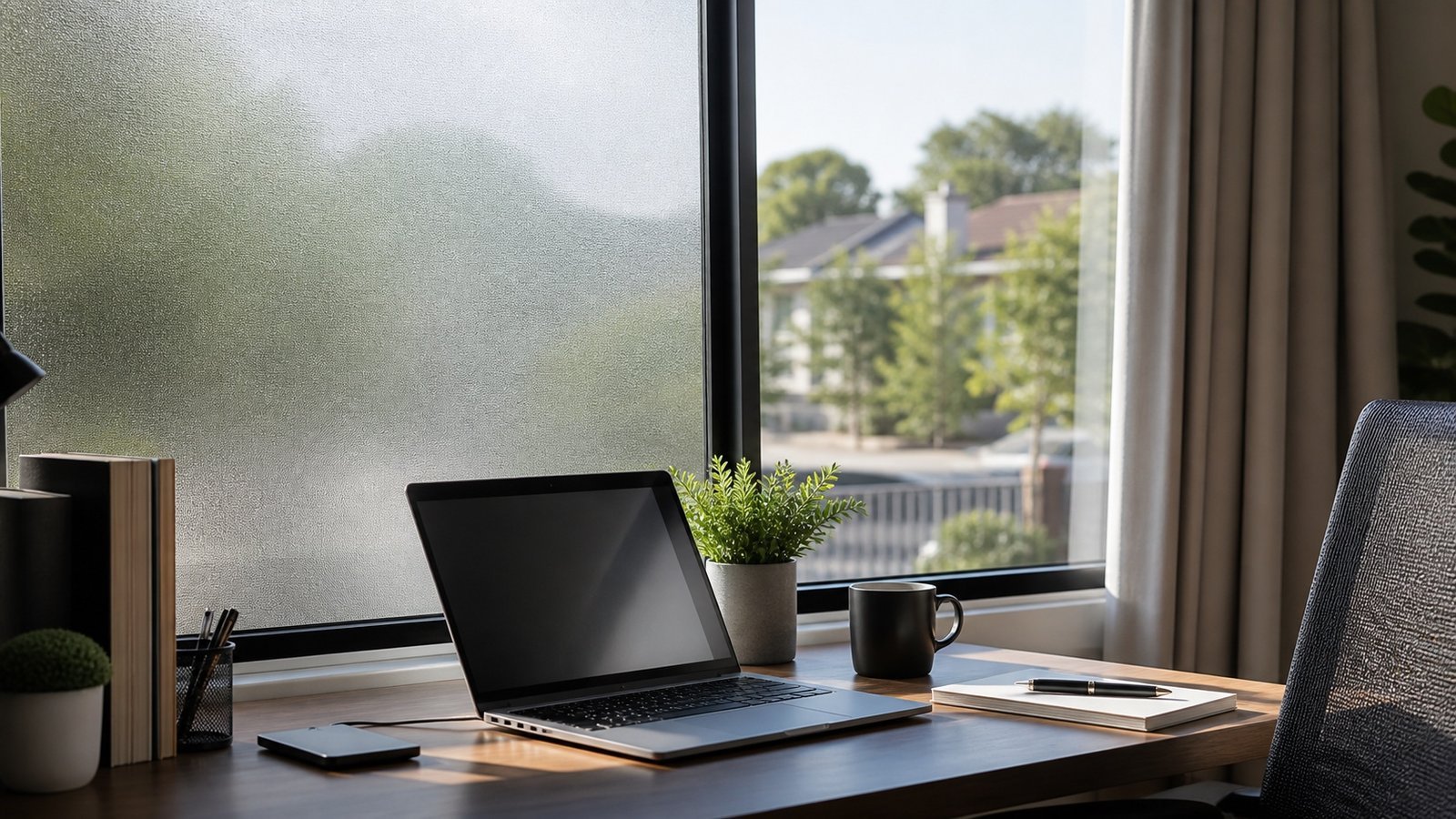
Window film is worth considering when the problem is visibility into a room, screen glare, UV exposure, or heat gain. It is not a replacement for blinds at night: one-way privacy film usually works only when the outside is brighter than the inside. For home offices, combine film with screen positioning and a privacy filter.
Choose by privacy problem
| Problem | Best film type | Good for | Limit |
|---|---|---|---|
| People can see in during the day | Reflective or tinted privacy film | Street-facing rooms | Privacy reverses at night if lights are on |
| You need privacy day and night | Frosted film | Bathrooms, sidelights, glass doors | Blocks clear view both ways |
| Screen glare | Solar control film | Home offices and bright rooms | May darken the room |
| Heat and UV | Heat-control or UV film | South-facing windows | Performance varies by glass and installation |
What window film can and cannot do
Window film solves a narrow problem well: it changes what someone can see through glass. It does not make a room private in every lighting condition, and it does not protect a screen that is visible from an angle inside the room. Treat it as one layer. The usual setup is film for the window, blinds or curtains for night, and desk positioning for the screen.
The daylight rule matters. Reflective and tinted one-way films work because the brighter side becomes harder to see through. During the day, that usually means a street-facing office can look private from outside. At night, when the room lights are on and the outside is dark, the effect can reverse. Frosted film is less subtle but more predictable because it blocks detail in both directions.
How to choose without overbuying
Start with the actual privacy failure. Stand outside in daylight, then again after dark with the room lights on. Check whether someone can see the desk, the monitor, family calendars, mail, medication labels, security equipment, or a whiteboard. If the issue is only glare on a screen, solar-control film may be enough. If the issue is people seeing into the room, choose frosted or reflective film based on whether you need a view out.
For renters, removable static-cling film is usually the lowest-risk test. For homeowners with large south-facing panes, heat-control film can be useful, but glass compatibility matters. Some films are not suitable for every double-glazed or treated window because heat build-up can stress the glass. Check the film maker’s compatibility notes before applying it to expensive panes.
Common mistakes
- Using one-way film as if it works at night. Keep blinds or curtains.
- Covering only the lower half of a window when a monitor is visible from an upper angle.
- Buying the darkest film first, then making the room uncomfortable to work in.
- Ignoring camera backgrounds: a video call can reveal more than the window does.
- Applying heat-control film without checking the glass type and warranty position.
The best privacy result is usually boring: a desk turned ninety degrees, a frosted strip where sightlines matter, and a blind that closes at night. Buy film only where it solves a sightline you have actually checked.
Home-office privacy setup
Film helps the room. It does not protect the screen. For sensitive work, position the desk so screens do not face windows, use a monitor privacy filter if people can walk behind you, and avoid video-call angles that reveal documents, family calendars, security devices, or mail on nearby surfaces.
Installation notes
- Measure each pane separately; older windows are not always square.
- Clean glass thoroughly before applying film.
- Use removable static-cling film if you rent or want a trial run.
- Check the film maker’s glass compatibility notes before applying heat-control film to double glazing.
- Keep blinds or curtains for night-time privacy.
The two-minute privacy test
Before buying film, do two checks with another adult. First, sit at the desk with a normal document or website open while the other person stands outside and at the room entrance. Second, repeat the test at night with the room lights on. If the problem appears only at night, film alone is the wrong fix. If the problem is screen angle from inside the room, move the desk or add a monitor privacy filter.
Where film fits in a broader setup
Window film pairs well with a home-office privacy plan: desk away from street-facing glass, camera pointed at a neutral background, documents off the desk, password-manager recovery details stored away from the workstation, and blinds closed after dark. It is a physical privacy tool, not a cybersecurity tool, but it reduces the casual exposure that leads to shoulder-surfing and accidental disclosure on calls.
If the room is used by children, guests, or an older parent, choose the least confusing setup. Frosted film on a sidelight or bathroom window is obvious and always-on. Reflective film requires someone to remember the night-time limitation.
Cost and reversibility
For uncertain rooms, start with a small pane or removable film before doing every window. The cheapest bad outcome is a test panel you remove. The expensive bad outcome is darkening a whole room, stressing unsuitable glass, and still needing blinds because the real problem was night-time visibility.
Sources and methodology
By The Connected Living Guide Team. This guide is based on product-documentation review, installation constraints, and practical privacy use cases, not source-backed claims audit. How we research.
Last editorial source pass: June 15, 2026.