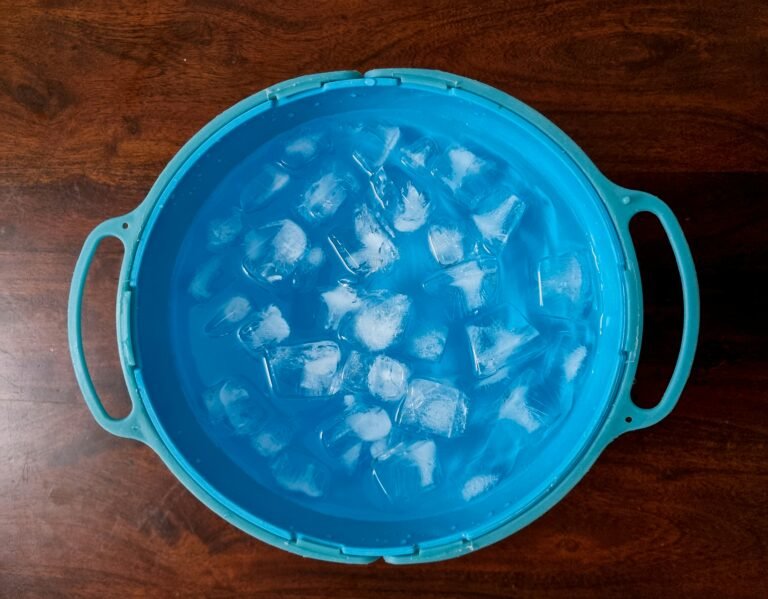
Ice maker vs freezer ice: the real difference
A freezer produces ice slowly (hours), in fixed cube sizes, and stores it until you need it. A countertop ice maker produces ice quickly (8-15 minutes for the first batch), continuously while plugged in, but does not freeze the ice – it stores it at ambient temperature in an insulated basket. Ice made earlier in the day will be partially melted by evening.
When a countertop ice maker wins:
– You need a lot of ice quickly (parties, events, summer entertaining)
– You want ice in a different location from your freezer (garage bar, outdoor kitchen, holiday cottage)
– You want nugget or bullet ice rather than standard cubes
When your freezer is fine:
– You need a small amount of ice for daily drinks
– You do not mind planning ahead
– You have an American-style fridge with a built-in ice maker
Types of ice
Not all ice makers produce the same shape:
Bullet ice: The default for most budget countertop ice makers. Hollow cylindrical pellets. Melts faster than solid ice because of the air pocket inside.
Nugget ice (chewable ice / Sonic ice): Soft, chewable, irregular pellets. Absorbs drink flavour rather than just chilling it. Extremely popular for cold drinks, smoothies, and cocktails. The GE Profile Opal produces nugget ice and has a cult following for this reason.
Crescent or cube ice: Harder, denser, melts more slowly. Better for drinks where dilution is a concern (whisky, cocktails). Less common in portable countertop models.
Best portable countertop ice makers in 2026
GE Profile Opal Countertop Nugget Ice Maker – best overall
The Opal is the machine that created significant consumer interest in countertop ice makers. It produces nugget ice – the soft, chewable ice associated with fast food fountain drinks and Sonic. If you have ever wondered why ice from a restaurant or bar tastes different, it is likely nugget ice.
Production: Up to 24 lbs (about 11 kg) of nugget ice per day. The side tank adds 3 lbs of additional water storage so it runs longer between refills.
Smart features: WiFi connected, app control (schedule ice production in advance), the app tracks water quality.
Noise: Louder than a bullet ice maker. Countertop nugget ice machines in general are noisy during production.
Size: Larger than bullet ice models – this is not a machine you will tuck away. It lives permanently on the counter.
GE Profile Opal 2.0 is the updated version with improved production speed and a cleaner design.
Best for: Anyone who loves chewable ice, cocktail enthusiasts, households where ice is consumed throughout the day.
Igloo ICEB26SS Countertop Ice Maker – best value bullet ice
The Igloo ICEB26SS is the benchmark for budget bullet ice makers. It produces 26 lbs of bullet ice per day in three selectable sizes (small, medium, large), starts making ice within 6 minutes, and the self-cleaning cycle is useful for maintenance.
Build quality is adequate. It is louder than you might expect. The transparent window on the lid is a nice touch for monitoring ice levels.
Best for: Anyone who needs a basic ice supply for parties, entertaining, or summer use without spending on nugget ice capability.
Frigidaire EFIC189-Silver – best compact option
The Frigidaire EFIC189 is one of the smallest countertop ice makers available. It produces 26 lbs per day in a genuinely compact footprint. First ice in about 7 minutes. Straightforward controls with no app or smart features.
Best for: Small kitchens, caravans, motorhomes, holiday rentals where counter space is at a premium.
Portable Tabletop Ice Maker – best for travel
For travel use specifically (camping, motorhomes, boat), a simpler 12V-compatible ice maker matters more than production capacity. Several brands make portable models with 12V car adaptors alongside standard plugs. Volume is lower (typically 12-15 lbs per day) but they can run from a vehicle power supply.
What the specs actually mean
Daily production (lbs/kg): Measured under ideal conditions (70F ambient air, 70F water). In a warm kitchen in summer, actual production is lower. For a party of 8-10 people using ice for drinks, 20 lbs per day is comfortably sufficient.
Cycle time to first ice: Usually 6-15 minutes. The first batch is typically 9-12 ice bullets. Faster is better for on-demand use but rarely a significant practical difference.
Water reservoir size: Larger is better for continuous production. A 2L reservoir produces roughly 2-3 batches before needing a refill.
Self-cleaning function: Important for maintenance. Hard water deposits build up inside. A self-cleaning cycle runs water and cleaning solution through the internal components. Run it monthly with a citric acid solution or the manufacturer’s recommended cleaner.
Placement and maintenance
Ventilation: Ice makers generate heat during the cooling process. Leave at least 15cm clearance on all sides. Do not put them in enclosed cabinets.
Water quality: Hard water causes mineral buildup that reduces efficiency and eventually damages the machine. A water filter or using filtered water extends the machine’s life significantly.
Descaling: Monthly for hard water areas. Weekly cleaning of the ice basket and interior is enough to prevent bacterial build-up in the water reservoir.
Storage: If storing for winter, drain completely, run the self-clean cycle, and store with the lid open slightly to prevent odours.
Common questions
Can I use the ice directly from the machine, or does it need to be transferred to the freezer?
You can use it directly. The machine stores made ice in an insulated basket. For longer storage, transfer it to a bag in the freezer. Ice made directly from the machine is best used within 4-6 hours.
Does a countertop ice maker use a lot of electricity?
Typical consumption is 100-200 watts during ice-making cycles. A machine running continuously uses roughly 1-2 kWh per day – similar to a refrigerator. For occasional party use, the electricity cost is negligible.
Why is my ice maker not making ice?
Check: reservoir is full, ambient temperature is below 35C (they struggle in very hot environments), the machine has been descaled recently, and the filter (if present) is not clogged.
Is nugget ice worth the premium?
For people who drink a lot of iced drinks, especially cocktails or cold brew, most find it significantly better than bullet or cube ice. The texture absorbs drink flavour rather than just chilling it, and it is satisfying to chew. For basic ice supply at a party, bullet ice is perfectly adequate.
Bottom line
For nugget ice lovers: GE Profile Opal – the gold standard for chewable ice, significantly better than anything cheaper for this specific style.
For basic ice supply: Igloo ICEB26SS or Frigidaire EFIC189. Both produce adequate bullet ice at reasonable prices.
For travel or space-constrained use: look for the smallest footprint model with a 12V adaptor option if needed.
Buy the right type of ice first – that narrows the field more than any other specification.