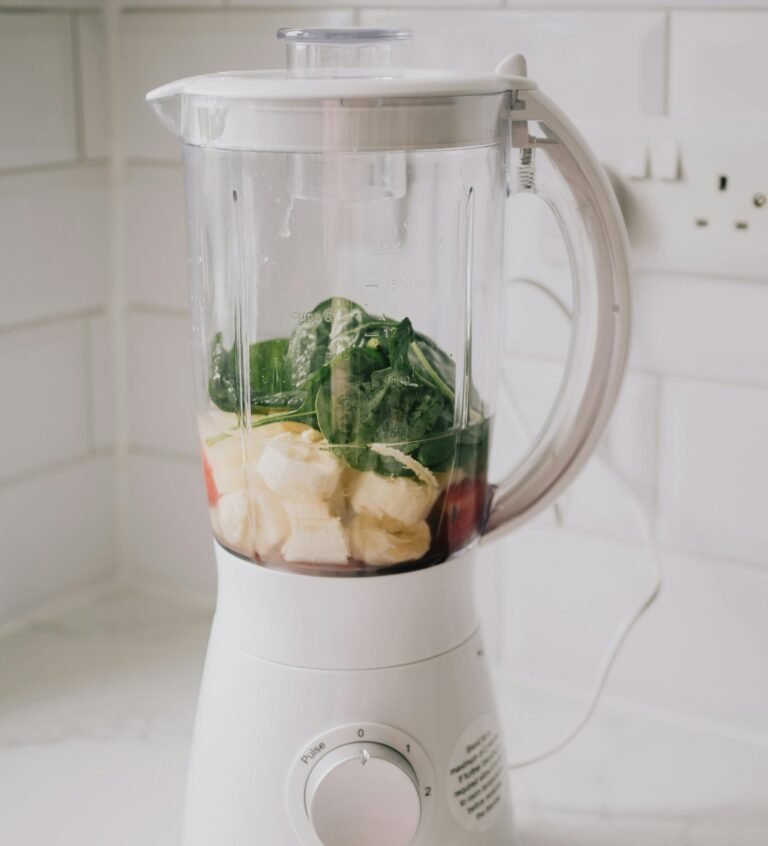
A good blender does more than most people expect. The best ones make smooth green smoothies with no fibrous chunks, hot soup directly from the blender jug (using friction heat), nut butter, frozen cocktails and baby food – all from one machine.
The bad ones leave stringy bits in smoothies, struggle with frozen fruit and burn out within 18 months.
This guide covers the key differences between budget, mid-range and premium blenders, then recommends the best options at each level.
Personal vs Full-Size Blenders
Personal / single-serve blenders (NutriBullet, Ninja Nutri-Blitz, etc.): Compact machines where the cup inverts over the motor and blends directly in the drinking container. Fast, convenient, easy to clean. Best for individual smoothies and protein shakes.
Full-size jug blenders: Larger capacity (1.5-2.5 litres), more powerful motors. Handle larger batches, hot liquids, nut butters and more demanding tasks. Best for families, batch cooking, or anyone who wants versatility beyond smoothies.
Key Specs to Understand
Motor wattage: More watts means more power for tough ingredients. 500-700W handles most smoothies. 1,000W+ handles frozen fruit, ice and fibrous greens properly. 1,500W+ (Vitamix territory) pulverises anything.
Blade design: The shape and sharpness of the blades determine blending quality more than raw power alone. Wide, sturdy blades create a vortex that pulls ingredients down into the blade zone.
Jug material: Tritan plastic jugs are BPA-free, lightweight and shatterproof. Glass jugs are heavy but scratch-resistant and do not absorb odours. Stainless steel jugs are opaque (you cannot see the contents).
Variable speed vs preset programs: Variable speed gives control. Preset programs (smoothie, soup, ice crush) are convenient for simple tasks.
The Best Blenders in 2026
1. Vitamix E310 Explorian – Best Overall
Vitamix is the benchmark for blending quality, and the E310 is their most accessible entry-point model for US buyers. The 1,400W motor powers stainless steel laser-cut blades that can blend anything: frozen fruit, whole almonds, raw carrots, ice – with complete smoothness.
The friction from the motor is sufficient to heat cold soup to steaming hot through blending alone in about 6 minutes – no heating element needed. Variable speed dial and pulse function give full control.
Built to last: Vitamix machines routinely last 10-20 years. The 5-year warranty reflects that confidence.
Price: Around $440-430
Motor: 1,400W
Capacity: 1.4 litres
Best for: Serious smoothie makers, batch cookers, those who want a blender that lasts a decade
What we like: Unmatched blending performance, self-cleaning (blend hot water with a drop of washing up liquid), 5-year warranty, genuinely heats soup
Worth knowing: Premium price; loud; the E310 is the entry-level Vitamix but still outperforms most other blenders
2. Ninja Professional Plus Blender BN750 – Best Mid-Range
Ninja’s Professional Plus is the best mid-range blender on the US market. The 1,200W motor and Total Crushing technology genuinely handles ice and frozen fruit without leaving chunks. Three preset Auto-iQ programs (smoothie, ice crush, extract) work well for daily use.
The 2.1-litre jug handles family batches, and two single-serve cups with to-go lids are included for personal smoothies.
Price: Around $110-130
Motor: 1,200W
Capacity: 2.1 litre jug + 700 ml cups
Best for: Families, those who want good performance without Vitamix prices
What we like: Excellent ice crushing, family-sized jug, to-go cups included, strong performance at this price
Worth knowing: More noise than premium models; the tall jug can be awkward in kitchens with low overhead cabinets
3. NutriBullet Pro 900 – Best Personal Blender
The NutriBullet Pro 900 is the defining personal blender. Simple operation – fill the cup, invert over the motor, press and twist – produces smooth, nutrient-extracted smoothies in under 60 seconds. The 900W motor handles spinach, kale, frozen berries and protein powder without complaint.
Easy to clean (just rinse the cup), compact storage, and the 24 oz cup is a sensible single-serve size.
Price: Around $70-80
Motor: 900W
Capacity: 700 ml / 900 ml cups
Best for: Daily smoothie drinkers, single households, desk workers who want quick morning nutrition
What we like: Very fast, easy to clean, compact, proven track record
Worth knowing: Not suitable for hot liquids or large batches; the motor can overheat if blended continuously for more than 60 seconds
4. KitchenAid K400 – Best for Kitchen Design
The K400 is the blender for those who want Vitamix-level design and finish without quite the Vitamix price. The die-cast metal base is available in the full KitchenAid colour range, and the soft-start and variable speed with pulse give genuine control.
Performance is strong (1,200W) – not quite Vitamix quality for very tough ingredients, but noticeably better than budget models.
Price: Around $250-280
Motor: 1,200W
Capacity: 1.55 litres
Best for: Those who care about kitchen aesthetics, KitchenAid enthusiasts
What we like: Beautiful design, premium build quality, available in every KitchenAid colour, strong performance
Worth knowing: Lighter than Vitamix on very tough tasks; premium price relative to performance
5. Kenwood Blend-X Pro – Best Budget Powerhouse
For those who want a powerful blender without mid-range or premium prices, the Kenwood Blend-X Pro delivers 1,200W performance at an accessible price point. The 2-litre jug handles family batches, and the 3D active blade system creates an effective vortex for consistent blending.
Not as refined as Ninja or KitchenAid, but a significant step up from sub-$65 budget blenders.
Price: Around $65-75
Motor: 1,200W
Capacity: 2 litres
Best for: Budget-conscious buyers wanting genuine power
What we like: Strong motor for the price, large jug capacity, widely available in US retailers
Worth knowing: Louder than premium models; build quality is functional rather than premium
Blender Cleaning Tips
The fastest way to clean any jug blender: fill halfway with warm water, add a drop of washing up liquid and blend on high for 30-60 seconds. Rinse and it is done. Never submerge the motor base.
For NutriBullet-style personal blenders: rinse the cup and blade assembly immediately after use. Food residue that dries is much harder to remove. The blade assembly on most personal blenders is not dishwasher safe (it dulls the blades over time).
What to Make Beyond Smoothies
Nut butter: Requires a 1,000W+ blender and patience. Blend toasted almonds or peanuts for 2-4 minutes, stopping to scrape down the sides. The friction releases the natural oils. No oil needs to be added.
Soup: High-powered blenders (Vitamix and equivalent) generate enough friction heat to warm soup. Start on low, increase to maximum, blend for 5-6 minutes for steaming hot soup. For lower-powered blenders, blend pre-cooked, pre-heated soup.
Frozen cocktails: Margaritas, daiquiris, pina coladas. Needs ice-crushing capability – at least 700W and robust blade design.
Baby food: A regular jug blender produces smoother purees than a stick blender for bulk batch preparation. Add the cooking liquid to thin to the right consistency.
FAQ
Is Vitamix worth the price?
If you blend daily and plan to use the machine for 5-10+ years: yes. The per-use cost works out significantly lower than cheaper machines that wear out faster. If you blend occasionally or are on a tight budget, the Ninja Professional Plus delivers very good results at a fraction of the price.
Can I make hot soup in a blender?
In a Vitamix or similarly powerful blender: yes, through friction alone. In other blenders: only with pre-cooked, hot ingredients added carefully. Never fill a jug blender more than halfway with hot liquid – steam pressure can blow the lid off.
What is the difference between a blender and a food processor?
Blenders handle liquid-based tasks (smoothies, soups, sauces). Food processors handle dry or semi-dry tasks (chopping vegetables, pastry, slicing). Some blenders come with food processor attachments but a dedicated food processor is more effective for those tasks.
Final Verdict
For the best blending results regardless of price: Vitamix E310. For the best mid-range performance: Ninja Professional Plus. For daily personal smoothies: NutriBullet Pro 900. For kitchen aesthetics: KitchenAid K400. For the tightest budget with real power: Kenwood Blend-X Pro.